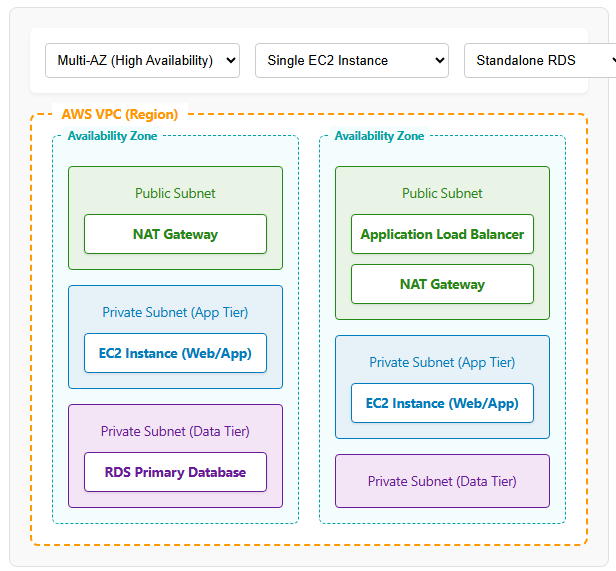
The Dynamic 3-Tier Cloud Infrastructure
Resilient Architecture: The 3-Tier Cloud InfrastructureDesigning resilient cloud infrastructure, whether to facilitate large volumes of e-commerce transactions or business operations in general, cannot be accomplished by implementing a flat network design, which makes 3-Tier Architecture the best solution for the problem of balancing stringent security perimeters and scalability.
In such architecture, each workload will be separated in logical tiers to guarantee that there will be no backend processes exposed to the Internet:
Tier 1: Presentation (Public Subnets): This is the entrance. There is an Application Load Balancer to distribute the load and protect the compute tier.
Tier 2: Application (Private Subnets): The core of the architecture. Auto Scaling Groups adjust compute capacity depending on current demand.
Tier 3: Data (Isolated Private Subnets): The most important tier. Using a primary relational database with a Multi-AZ Read Replica is a good way to achieve fast failover and data preservation during disaster.
The transition to multi-AZ, auto-scaled environment changes the focus from “how quickly we recover” to “how do we cope with unprecedented load.”
Layering Security: Perimeter Defense and Zero Trust
A resilient architecture only stands up if its security position is adequate. To guarantee students’ information protection and safety of the financial transactions, the above architecture has a layered approach:
Zero Trust & IAM: Within the private subnets, least privilege principle is used. Instead of using static passwords for the access to other resources, compute instances use temporary roles of IAM.
Strict Security Groups: Network access is explicitly allowed. Database layer receives connection requests only from the particular security group related to the application layer and is thus invisible for all other parts of the network.
The Business ImpactApart from the technical aspect, security becomes a factor of enabling business. The above implementation provides strict compliance with data protection rules, protects the reputation of the academy, and guarantees focus only on medical training.
The Proving Ground: Enterprise Infrastructure at Home
A homelab is simply the best R&D lab one can imagine, where all sorts of concepts of networking, containers, and disaster recovery are put to practice in a living system before applying them to production.
Hardware Layer: The physical layer is composed of a special routing edge (pfSense/OPNsense) connected to a Layer 2/3 managed switch. The compute is done by a Proxmox hypervisor and storage by a separate NAS with data stored on ZFS.
Containerization: All services are implemented within Docker containers on top of lightweight Linux Containers (LXC). This allows quick setup and destruction of staging systems, reverse proxies, and monitoring services.
Zero-Trust Networking: There are no flat networks here. Segmentation is implemented using VLAN tagging. Management traffic, server-to-server communication, and IoT devices are completely isolated from each other, following a strict firewall policy.
This is a living platform where various concepts of automated deployments and self-hosted access from outside are implemented and tested.
While hands-on experience in the homelab and production environments drives my architectural decisions, formalizing that knowledge ensures alignment with industry best practices.
The security paradigms, high-availability setups, and 3-tier cloud architectures detailed in my projects are heavily informed by my completion of the AWS Cloud Technology Consultant Professional Certificate.
This rigorous curriculum provided deep, validated expertise in:
-Architecting scalable and resilient cloud infrastructures.
-Deploying defense-in-depth security models using IAM, WAF, and isolated VPCs.
-Translating complex business requirements into cost-effective, high-performance AWS deployments.
View the AWS Cloud Technology Consultant Professional Certificate on Coursera
Leave a Reply